In late 2025, the U.S. immigration landscape underwent a major shift. As of December 15, 2025, the Department of State (DOS) and USCIS expanded mandatory social media vetting to nearly all nonimmigrant visa categories, including H-1B, H-4, F, M, B1/B2 and J applicants. If you are heading for a visa interview or filing an extension, your digital footprint is now as important as your financial records. Here is a guide on what the U.S. government is validating, what they are looking for, and how to manage your accounts without triggering a “red flag.”
U.S. Visa Social Media Rules
- 1. The New Rule: “Public Profiles Only”
- 2. What Exactly is the U.S. Government Validating?
- 3. Top Social Media Red Flags in 2025
- 4. How to Manage and “Clean Up” Your Social Media
1. The New Rule: “Public Profiles Only”
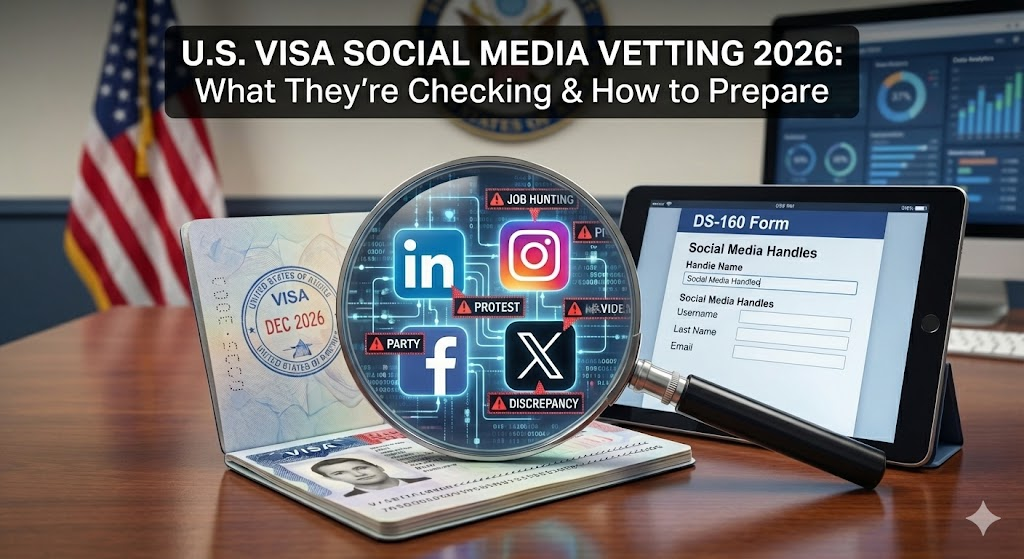
The 2025 update mandates that applicants must not only disclose their social media handles from the past five years on Form DS-160 but must also set their profiles to “Public” for the duration of the visa process.
Consular officers now have explicit instructions to review these profiles to verify identity and admissibility. If your accounts are private or inaccessible during the review, you may face significant delays, a 221(g) administrative processing notice, or an outright denial.
2. What Exactly is the U.S. Government Validating?
The vetting process is designed to ensure you “do not intend to harm Americans or U.S. national interests.” Specifically, officers and AI-driven tools are looking for:
- Consistency Check: Does your LinkedIn profile match your H-1B petition? They will verify job titles, dates of employment, company names, and educational degrees. Any mismatch (e.g., a “Manager” title on LinkedIn vs. “Developer” on a petition) can trigger a fraud investigation.
- National Security & Values: Following the 2025 USCIS Policy Manual updates, officers are screening for “anti-American” ideologies, support for terrorist organizations, and involvement in antisemitic activity or hate speech.
- Immigrant Intent: For non-immigrant visas (like F-1 or B-1/B-2), posts that suggest you plan to stay in the U.S. permanently—such as “Looking for a job in the U.S.” or “Selling all my belongings to move to America”—can lead to a denial under Section 214(b).
- Unauthorized Work: Photos or posts showing you working while on a previous tourist or student visa are major red flags for “unauthorized employment.”
3. Top Social Media Red Flags in 2025
- Illegal Activities: Mentions or photos involving drug use (even if legal in your home country/state), violence, or fraud.
- Extremist Content: Supporting or sharing content from designated foreign terrorist organizations or hate groups.
- Contradictory Travel History: Posting photos from a country you didn’t list in your travel history on the DS-160.
- Sensitive Tech Exposure: If you work in high-tech fields (AI, Quantum, Biotech), any posts suggesting the intent to export sensitive U.S. research to adversarial nations will lead to an immediate “Security Advisory Opinion” (SAO).
4. How to Manage and “Clean Up” Your Social Media
Many applicants make the mistake of abruptly deleting their accounts right before an interview. Do not do this. Abrupt deletion is a “red flag” that suggests you are hiding something. Furthermore, the U.S. government uses AI tools that can access cached versions of pages or indexed Google results.
Strategic Cleanup Steps
- Audit Your History: Use tools like Redact.dev or TweetDelete to search for keywords related to politics, protests, or controversial topics.
- Focus on Deletion, Not Deactivation: Instead of deactivating your whole profile, delete specific, problematic posts or comments.
- Correct Your LinkedIn: Ensure your professional profile is a 100% match with the resume and petition you submitted. This is the most common reason for H-1B administrative processing.
- Check Your Tags: Go to your “Tagged Photos” settings. You might be clean, but a friend’s photo of you at a protest or a party might not be. Untag yourself from anything questionable.
- Declare Everything: On the DS-160, list all handles, including inactive ones or those under pseudonyms. Failure to disclose an account that the government later discovers is considered material misrepresentation, which can lead to a lifetime ban.